Affiliate Disclosure: Some links here are affiliate links, and the free workshop we mention is one we promote as an affiliate. If you register and later buy something, we may earn a commission at no cost to you. The workshop is free to attend. We only point you toward things we think are genuinely useful.
Scroll through the faceless side of Pinterest for two minutes and you’ll notice a look. Soft neutral tones. A laptop open on a tidy desk. A coffee cup catching morning light. A hand, maybe, but never a face. It’s calm, it’s aspirational, and it’s everywhere, because the faceless aesthetic has quietly become its own visual language.
There’s a real reason this look works, and it’s worth understanding whether you’re drawn to it or just curious why every “make money online” account seems to share the same palette. Let’s break down what the faceless aesthetic actually is, why it sells, and the trap of falling in love with it for its own sake.
Why a “Look” Matters When There’s No Face
When you build a normal personal brand, your face does a lot of quiet work. It creates recognition, consistency, and a sense of “this is a real person.” People scroll past a thousand posts a day and your face is a familiar anchor in the noise.
Take the face away and something has to do that job instead. That something is the aesthetic. A consistent visual style becomes your recognition. When every pin, cover, and post shares the same palette and mood, people start to recognize you without ever seeing you. The look becomes the brand. That’s not vanity, it’s a practical substitute for the recognition a face would have provided.
What the Faceless Aesthetic Is Actually Made Of
Strip it down and the popular version of this look is built from a few repeatable ingredients.
- A restrained palette. Usually warm neutrals, creams, soft beiges, muted earth tones, with one quiet accent. Calm, not loud.
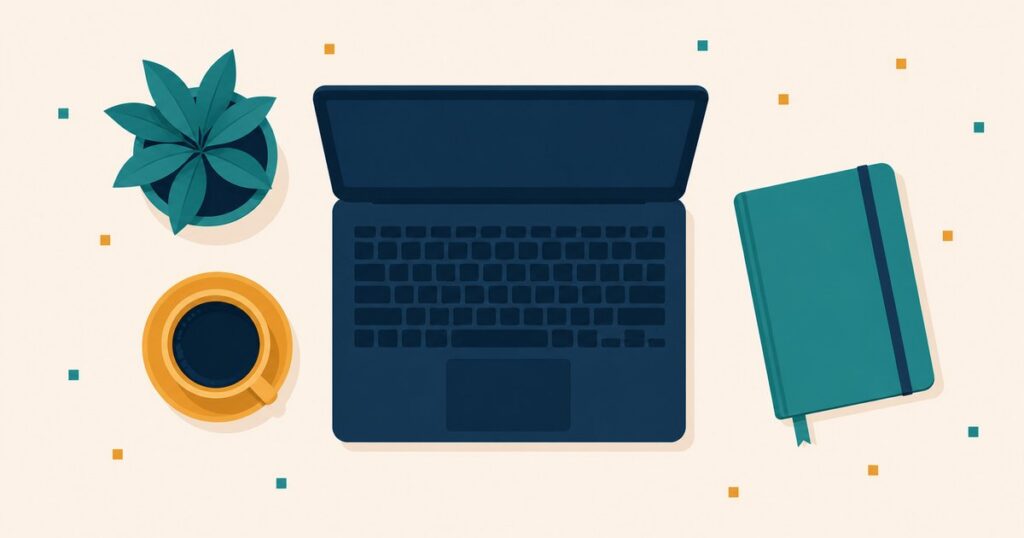
- Lifestyle imagery without people. The laptop, the coffee, the notebook, the plant, the clean desk. Objects that imply a calm, capable life.
- Lots of breathing room. Space around everything. Cramped design reads as cheap; airy design reads as premium.
- Clean, simple type. One or two fonts, never a jumble. The words are the message, so they stay legible and calm.
- Consistency above all. The same treatment applied everywhere, so the whole feed looks like it came from one deliberate hand.
What all of this signals, quietly, is this person has their act together. And that impression is doing sales work before a single word is read. People are more likely to trust and buy from something that looks calm and considered than from something that looks chaotic.
Match the Aesthetic to the Buyer, Not Your Own Taste
Here’s a nuance most people miss. The soft-neutral look isn’t the only “premium” aesthetic, and it isn’t automatically right for your product. It reads as premium to a wellness, lifestyle, or feminine-entrepreneur audience. But a bold, high-contrast, confident look reads as premium to a business, finance, or productivity audience.
The mistake is choosing a palette because it’s trending on your own feed, rather than because it speaks to the person you’re selling to. Your aesthetic is a form of communication. Point it at the buyer. A meticulously styled cream-and-beige brand will underperform if it’s trying to sell a no-nonsense productivity tool to people who’d trust something sharper.
If you want to go deeper on building a look that reads as high-end without design skills, we cover the palette and mockup mechanics in detail in our post on making your digital product shop look premium.
The Trap: When the Aesthetic Becomes the Whole Plan
Now the honest warning, because this is where a lot of people quietly lose months.
It is very easy to fall so in love with building a beautiful faceless brand, the perfect palette, the dreamy pins, the cohesive feed, that you forget the aesthetic was supposed to be selling something. A gorgeous account with no product and no offer is a mood board, not a business. The look is the wrapping. It is not the gift.
I’ve watched people spend weeks perfecting their visual identity and zero time on the thing that actually pays: a product worth buying and a way to get it in front of people. The aesthetic improves your conversion, it helps the people who arrive decide to trust you. It does nothing to bring those people in, and it can’t tell you what to charge or what to sell. Beauty is a multiplier. If what it’s multiplying is zero, the answer is still zero.
Aesthetic First, or Substance First?
The healthy order is substance first, polish second. Decide who you help and what you sell them. Make the product. Set up a way to reach buyers, which for faceless businesses usually means Pinterest and search feeding a blog or shop. Then layer the aesthetic on top to lift how it all performs.
Done in that order, the beautiful brand is an accelerant on a working engine. Done in the wrong order, it’s a very pretty car with no motor. Both look great parked. Only one of them takes you anywhere.
And the reassuring part is that you can begin the substance side with nothing, no audience and no following, because faceless traffic comes from search, not followers. We lay out that starting-from-zero path in how to sell with no audience if that’s the piece you’re missing.
Where the Engine Gets Built
If you’ve got the aesthetic instinct, or you’re close, the thing worth your energy next is the engine underneath it: the product, the offer, and the system that sells while you sleep. That’s the part a beautiful feed can’t give you, and it’s the part most worth learning properly.
There’s a free live workshop I recommend for this. It’s hosted by John Thornhill, who has built digital product businesses for well over a decade, and it walks through how to build the selling system that a faceless brand needs underneath its pretty surface. It’s free to attend, and it’s the natural complement to a shop that already looks the part.
So enjoy building the beautiful faceless brand, it genuinely helps. Just make sure there’s a real product and a real system living underneath the palette. The aesthetic gets people to lean in. Something has to be there when they do.
Free to attend. Bring your carefully curated brand, or just the idea of one.