Affiliate Disclosure: Some links in this post are affiliate links. If you buy through them, we may earn a commission at no extra cost to you.
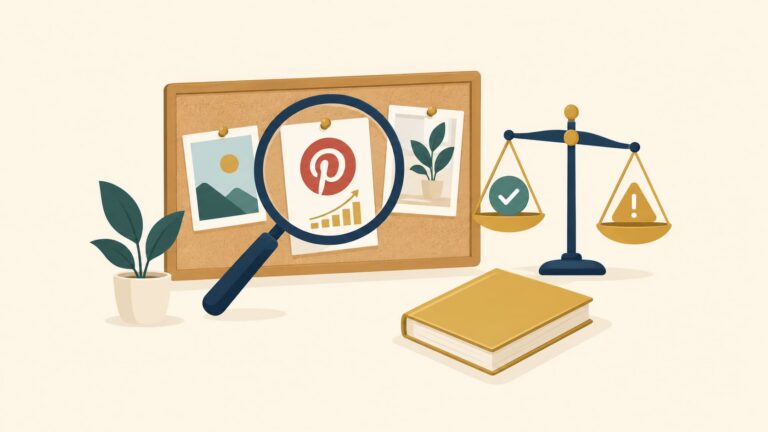
If you’ve spent any time on Pinterest lately, you’ve seen the pins. “Make money without showing your face.” “I quit my job with faceless digital marketing.” “Earn while you sleep, no camera needed.” Some of them feel genuinely helpful. A lot of them feel like a pyramid scheme wearing a nice font. So which is it? Is faceless digital marketing a real way to earn, or just the latest online money fantasy?
The answer is: both, depending on what exactly someone is selling you. Let’s separate the legitimate model from the hype around it, because the difference matters and almost nobody spells it out.
The Short Answer
Faceless digital marketing, as a business model, is completely legitimate. Selling useful digital products through channels like Pinterest, search, and email, without putting your face on camera, is a real and proven way people earn money. There’s nothing fake about it. Businesses have sold things without a spokesperson’s face for as long as commerce has existed.
What’s often not legitimate is a specific flavor of it being pushed hard right now: a recycled product, sold to you with a promise of easy riches, whose main purpose is for you to resell the same product to the next person. That version has more in common with a chain letter than a business. So the model is real. Some of the people selling it are running a very different game. Learning to tell them apart is the whole skill.
The Legitimate Version, Plainly
Here’s what the real thing looks like, with no mystique. You identify a group of people with a problem. You create a genuinely useful digital product that helps them, a template, a guide, a course. You make content that reaches those people through search and Pinterest. Some of them buy. You keep improving and adding products over time. Income grows as your catalog and your traffic grow.
That’s it. It’s not exotic. It’s the same fundamentals as any product business, just delivered digitally and marketed without a personal brand. It works because digital products cost nothing to duplicate, and because search-driven platforms send you buyers based on what they want, not on who you are. If you’d like the full walkthrough of the mechanics, we cover them in our guide to faceless digital marketing for beginners.
The Red Flags That Signal Hype
Now the part that protects your wallet. Here’s how to spot the version that’s more scheme than business.
- The product is “the course that teaches you to sell this course.” If the main thing being sold is resell rights to the very guide you’re buying, and everyone’s income comes from recruiting more buyers, be extremely careful. That’s a loop that mostly enriches the people at the top.
- Income claims with no work attached. “$5,000 a month on autopilot in 30 days” is a fantasy. Real digital businesses have a build phase and a slow start. Anyone hiding that is selling a feeling, not a plan.
- Screenshots of earnings as the main proof. Earnings screenshots are the easiest thing on the internet to fake or cherry-pick. A legitimate teacher explains the method; a hype merchant just flashes a dashboard.
- Urgency and scarcity everywhere. “Only 3 spots left, price goes up at midnight” on an evergreen digital product is a manipulation tactic, not a real constraint.
- No actual product for the customer. If you can’t clearly answer “what does the end buyer get and why would they want it,” there’s no business underneath the marketing.
None of these red flags are subtle once you know to look. The trouble is that the hype is loud and the legitimate version is quiet, so newcomers hear the scheme first. To see these checks applied to one popular course, read our breakdown of whether Faceless Income With Pinterest is legit or a scam.
“But Can a Normal Person Actually Make Money?”
Yes, with two caveats. First, it takes real work up front, building a product and the content that sells it, before meaningful money shows up. Second, results vary enormously, and most people who “fail” simply stopped during the unglamorous early phase when nothing was selling yet.
What makes it genuinely accessible is that the barriers are low. You don’t need a big budget, a following, or a face on camera. You can start from zero, which we make the full case for in selling digital products with no audience. But low barriers to entry are not the same as no effort required. The people quietly succeeding treated it like a business, not a lottery ticket.
The Expectations to Set
If you go in expecting a quick, effortless windfall, you’ll be disappointed and you’ll quit, right on schedule. If you go in expecting to build a small asset over a few months, one that then earns with much less ongoing effort, you’ll be looking at it correctly.
The genuine appeal isn’t “get rich this week.” It’s that you can build something that keeps earning after the work is done, without needing to be a public personality to do it. That’s a real and valuable thing. It’s just not the thing the loudest pins are promising. We’re equally frank about the timeline in our piece on what passive income really involves.
How to Learn It From Someone Credible
Since credibility is the whole issue with this topic, the sensible move is to learn the real model from someone with a long track record, not a fresh account flashing a Lamborghini.
There’s a free live workshop I recommend on exactly this. It’s hosted by John Thornhill, who has spent well over a decade actually building and selling digital products, long before “faceless” was a trending hashtag. It walks through how to build a genuine digital product business, the legitimate engine underneath the faceless model, without the get-rich-quick nonsense. It’s free to attend, and it’s a far more grounded starting point than most of what’s floating around Pinterest.
So is faceless digital marketing legit? The model, yes, genuinely. The hype around it, often not. Keep your skepticism, ignore the screenshots, learn the real fundamentals, and you’ll be one of the few who actually treats this like the business it can be.
Free to attend. No hype, no income guarantees, just how the real model works.
Keep Reading
- Faceless digital marketing for beginners: how the model works
- What changed my mind about faceless digital marketing
- 30 faceless digital product ideas to sell without being on camera
- Is Faceless Income With Pinterest legit or a scam?
- Faceless YouTube: Tube Mastery and Monetization alternatives compared
- Can you make money on Threads? What actually pays